- Home
- About Us
- Products
- Aluminum Ceramic Cookware
- Aluminum Ceramic Cookware Set
- Aluminum Ceramic Kitchenware Set
- Aluminum Ceramic Fry Pan
- Aluminum Ceramic Deep Fry Pan
- Aluminum Ceramic Sauce Pan
- Aluminum Ceramic Casserole
- Aluminum Ceramic Grill Pan
- Aluminum Ceramic Pizza Pan
- Aluminum Ceramic Wok Pan
- Aluminum Ceramic Dutch Oven
- Aluminum Ceramic Saute Pan
- Aluminum Non-Stick Cookware
- Aluminum Non-Stick Cookware Set
- Aluminum Non-Stick Kitchenware Set
- Aluminum Non-Stick Fry Pan
- Aluminum Non-Stick Deep Fry Pan
- Aluminum Non-Stick Sauce Pan
- Aluminum Non-Stick Casserole
- Aluminum Non-Stick Grill Pan
- Aluminum Non-Stick Pizza Pan
- Aluminum Non-Stick Wok Pan
- Aluminum Non-Stick Dutch Oven
- Aluminum Non-Stick Saute Pan
- Composite Stainless Steel Non-Stick Cookware
- Aluminum Ceramic Cookware
- Cases
- News
- Download
- Send Inquiry
- Contact Us

Aluminum Non-Stick Cookware Sets: What to Check Before You Place an Order
If you're sourcing an aluminum non-stick cookware set, you've probably noticed that most of what's online is written for people cooking dinner, not for people buying 5,000 of them. This guide is for the other group: brand owners, retailers, distributors and Amazon sellers who need to know what they're actually getting before a purchase order goes out.
A set looks simple from the outside. A few pans, a few lids, maybe a spatula. The differences that matter are the ones you can't see in a product photo.
What you're actually buying
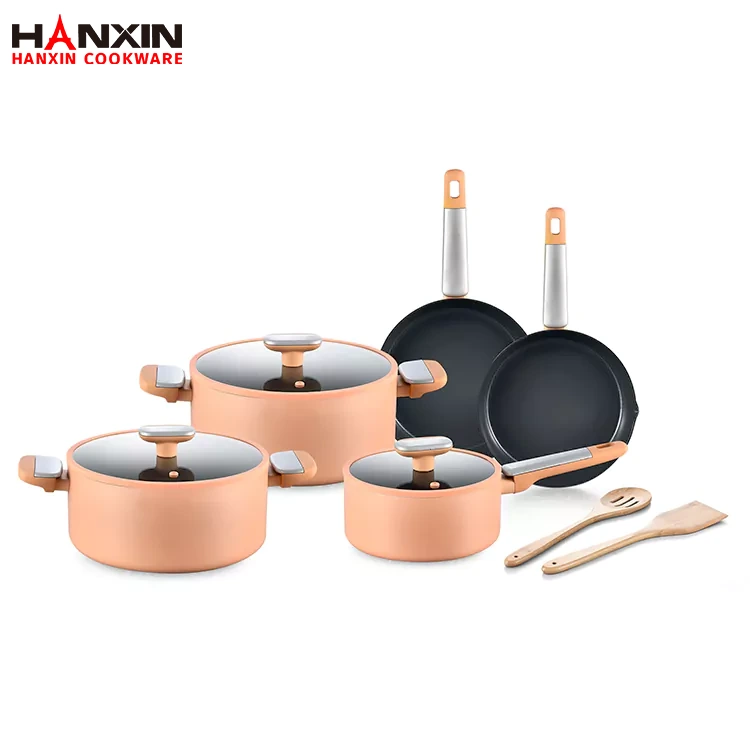
An aluminum non-stick cookware set is a matched group of pans and pots sold together, with a non-stick coating bonded to an aluminum body. Most sets in this category land between 8 and 12 pieces, though "pieces" is a slippery word. Some suppliers count lids. Some count the plastic spatula. Always ask for the exact item list, not the number printed on the box.
A typical set might include an 8-inch and a 10-inch frying pan, a 1.5QT and a 2QT sauce pan, and a 4QT casserole or stock pot, sometimes a wok or a sauté pan, plus lids. What's in the set matters more than how many pieces there are. A 12-piece set padded out with three spare lids is worse value than a well-chosen 8-piece one.
Why aluminum, and which aluminum
Aluminum heats fast, spreads that heat evenly, and is light to lift. That's the whole reason it dominates the non-stick category. But "aluminum" covers more than one way of making a pan, and they don't behave the same.
· Die-cast aluminum is poured into a mold. It's thicker and heavier, holds heat well, and shows up in the better sets.
· Stamped (spun) aluminum is pressed from sheet metal. Lighter and cheaper, fine for everyday pans, but prone to warping if the gauge is too thin.
Thickness is worth asking about directly. For stamped pans, roughly 1.8mm to 2.5mm is a workable range; die-cast bodies run thicker. Thin pans heat quickly but dent and warp, and they're a common source of warranty claims once a set reaches customers.
One more point that gets missed: aluminum on its own doesn't work on an induction hob. If your market sells induction cooktops, the set needs a magnetic stainless steel base bonded to the underside. Don't assume it's there. Ask.
The coating conversation
This is where most buyer questions land, and where most marketing is least useful.
Two families dominate. PTFE-based coatings, the family that includes Teflon (a brand name, not a material), are slick, durable and cheap to apply. They have been made PFOA-free since around 2013, so "PFOA-free" is now a baseline expectation rather than a selling point. Ceramic coatings come from a silica-based sol-gel. They contain no PTFE at all and appeal to buyers who want a chemical-free story, but they wear out faster, often inside one to three years depending on use.
Neither is a bad choice. They suit different customers. PTFE is the workhorse for price-sensitive and high-turnover markets. Ceramic sells where health positioning drives the purchase. A supplier who offers only one and tells you it's the best is talking about their production line, not your market.
Ask about layer count too. A two-coat system and a five-coat system both get called "non-stick," but they age very differently. If durability is part of your pitch, get the abrasion-cycle test numbers in writing.
A checklist before you sign
Here's what I'd put on a spec sheet before requesting quotes:
· Exact item list and sizes, with lids counted separately.
· Body material and gauge: die-cast or stamped, and how thick.
· Coating type, brand and layer count, and whether it's PFOA-free or PTFE-free as your market requires.
· Handle material and attachment. Bakelite and phenolic stay cool and cost less; stainless steel looks better and can go in the oven. Riveted handles outlast glued ones.
· Oven-safe temperature, if that matters to your customers.
· Induction compatibility, if your market needs it.
· Certifications: FDA and LFGB for food contact are the usual asks; SGS reports, ISO 9001 and BSCI audits matter to larger retailers.
· Packaging: retail color box, master carton, drop-test standard, and whether it's ready to ship direct to consumers.
· MOQ, lead time, and what a sample costs.
That last line saves more time than any other. A supplier who won't send a sample before you commit to a 20-foot container is a supplier to think twice about.
Making the set your own
For most buyers in this category, the point is a private-label or OEM/ODM arrangement. An aluminum non-stick cookware set takes customization well because the tooling is flexible and the visual changes are easy to see.
Common options: logo application by pad print, laser etch or embossing on the handle; custom colors for the body and coating; handle and knob design; and retail packaging built around your brand. Deeper ODM work means a new shape or pan profile, which usually brings a mold fee and a longer development cycle.
The useful question to ask a manufacturer isn't "can you customize." Everyone says yes. It's "what have you already made for other brands, and can I see it." A factory that has shipped similar sets to Europe or North America has already solved most of the problems you're about to hit.
Mistakes I keep seeing
Buying on piece count. Covered above, but worth repeating because it's still the easiest way to overpay.
Skipping the sample round. Photos and spec sheets don't tell you how a handle feels or whether a lid rattles in its box.
Assuming certifications transfer. A certificate belongs to a specific product and material. Ask for the report that matches the set you're ordering, not a generic one framed on the factory wall.
Frequently asked questions
What is usually included in an aluminum non-stick cookware set? Most sets include frying pans, sauce pans and a casserole or stock pot, with matching lids. Counts commonly run from 8 to 12 pieces, but the contents vary, so confirm the item list with the supplier rather than trusting the number on the box.
Are aluminum non-stick cookware sets safe? Both main coating types sold today are food-safe when made to spec. PTFE-based coatings are now PFOA-free, and ceramic coatings contain no PTFE. Look for food-contact certification (FDA or LFGB) and follow the care instructions. Overheating an empty pan is the main thing to avoid.
Can these sets be used on induction cooktops? Only if they have a magnetic stainless steel base. Plain aluminum won't engage an induction hob. Confirm the base construction before ordering if induction is a target market.
What is the minimum order quantity for a custom cookware set? It depends on how deep the customization goes. Printing a logo on an existing set carries a modest MOQ; a new shape or mold raises it. Ask the factory for both numbers so you have something to compare.
How long does a non-stick coating last? PTFE coatings typically last several years with normal use. Ceramic coatings are shorter-lived, often one to three years. Care habits matter more than coating type, so include care instructions with any retail set.
Ready to source?
If you're looking at aluminum non-stick cookware sets for your brand, the fastest route to a useful answer is to talk to the factory directly. Send your spec list, ask for a sample, and get a quote on the exact set you want to sell.
Related News
- How Does a CD Bottom Improve Aluminum Ceramic Cookware Performance?
- Why Choose Tri-Ply Steel Composite Non-Stick Cookware for Modern Kitchens?
- How Does an Aluminum Non-Stick CD Bottom Wok Pan Improve Stir-Frying Performance?
- Why Is an Aluminum Non-Stick Casserole Ideal for Everyday Family Cooking?
- Why is an Aluminum Non-Stick Sauce Pan the Best Choice for Everyday Cooking?
- Why Is Aluminum Non-Stick Deep Fry Pan the Best Choice for Modern Cooking?
Leave me a message
New Products


News Recommendations