- Home
- About Us
- Products
- Aluminum Ceramic Cookware
- Aluminum Ceramic Cookware Set
- Aluminum Ceramic Kitchenware Set
- Aluminum Ceramic Fry Pan
- Aluminum Ceramic Deep Fry Pan
- Aluminum Ceramic Sauce Pan
- Aluminum Ceramic Casserole
- Aluminum Ceramic Grill Pan
- Aluminum Ceramic Pizza Pan
- Aluminum Ceramic Wok Pan
- Aluminum Ceramic Dutch Oven
- Aluminum Ceramic Saute Pan
- Aluminum Non-Stick Cookware
- Aluminum Non-Stick Cookware Set
- Aluminum Non-Stick Kitchenware Set
- Aluminum Non-Stick Fry Pan
- Aluminum Non-Stick Deep Fry Pan
- Aluminum Non-Stick Sauce Pan
- Aluminum Non-Stick Casserole
- Aluminum Non-Stick Grill Pan
- Aluminum Non-Stick Pizza Pan
- Aluminum Non-Stick Wok Pan
- Aluminum Non-Stick Dutch Oven
- Aluminum Non-Stick Saute Pan
- Composite Stainless Steel Non-Stick Cookware
- Aluminum Ceramic Cookware
- Cases
- News
- Download
- Send Inquiry
- Contact Us

How Does a CD Bottom Improve Aluminum Ceramic Cookware Performance?
A CD bottom plays an important role in cookware stability, stovetop compatibility, and heat transfer. In this article, we explain how CD bottom construction supports aluminum ceramic cookware, what to consider when selecting a kitchenware set, and how coating performance and base design work together in daily cooking. Drawing on our cookware manufacturing experience, HANXIN also shares practical considerations for product selection and OEM/ODM development.
Table of Contents
- What Is a CD Bottom in Aluminum Ceramic Cookware?
- How Does a CD Bottom Improve Cookware Performance?
- How Do Aluminum Construction and Ceramic Coating Work Together?
- Key Specifications of an Aluminum Ceramic CD Bottom Kitchenware Set
- Where Can This Cookware Set Be Used?
- What Should You Check Before Choosing a Cookware Set?
- How Does HANXIN Support Cookware Manufacturing and Customization?
- Frequently Asked Questions
What Is a CD Bottom in Aluminum Ceramic Cookware?
A CD bottom is a specially constructed cookware base designed to improve the contact between a pan and the stovetop. In aluminum cookware, the base structure matters because aluminum heats up quickly, while the bottom design helps determine how effectively heat reaches the cooking surface.
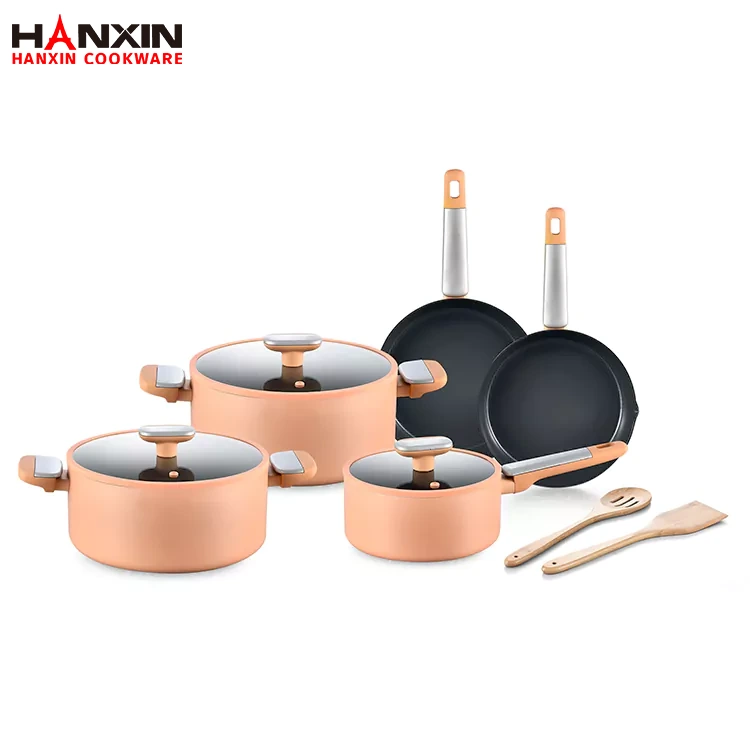
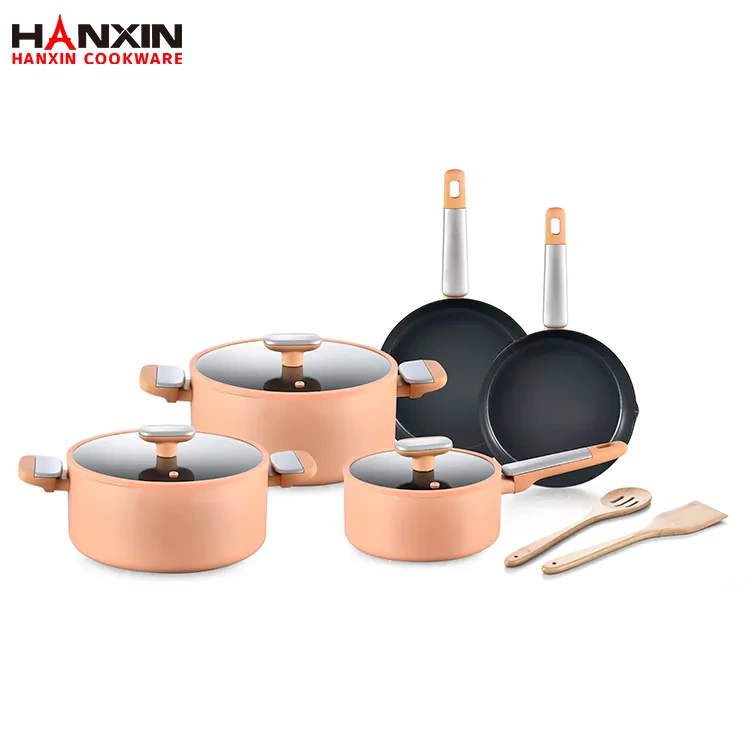
When we evaluate an Aluminum Ceramic CD Bottom Kitchenware Set, we look beyond the ceramic coating. The aluminum body provides relatively lightweight construction and responsive heating, while the reinforced base contributes to structural stability during repeated heating and cooling cycles.
The exact performance depends on the base materials, thickness, bonding process, and intended stovetop compatibility. A CD bottom should therefore be evaluated as part of the complete cookware structure rather than treated as a standalone quality indicator.
How Does a CD Bottom Improve Cookware Performance?
In daily cooking, the cookware base influences heating consistency, contact stability, and long-term usability. A properly engineered bottom can help improve these practical aspects.
1. More Consistent Heat Transfer
Aluminum is widely used in cookware because of its good thermal conductivity. A suitable base structure helps transfer heat from the stovetop into the aluminum body. This is useful when preparing eggs, vegetables, sauces, and other foods that require controlled heating.
However, a CD bottom does not automatically guarantee perfectly uniform heating. Pan diameter, aluminum thickness, burner size, and heat settings also affect temperature distribution. We recommend matching the cookware dimensions to the heating zone instead of relying on the bottom design alone.
2. Improved Base Stability
Repeated heating and cooling can place stress on cookware materials. The base structure needs to maintain good contact with the cooking surface and resist unwanted deformation under normal operating conditions.
For household cookware, this is particularly important when consumers regularly move between low and medium heat settings. A stable base helps the pan sit properly on the stovetop and makes everyday handling more predictable.
3. Better Practical Stovetop Compatibility
Cookware compatibility depends on the construction of its bottom. A CD bottom can be designed for particular stovetop requirements, but it should not automatically be considered compatible with every heat source.
Before selecting a cookware set for retail or wholesale distribution, we recommend confirming whether the specific model is suitable for gas, electric, ceramic, or induction cooktops. Induction compatibility requires an appropriate magnetic base structure.
How Do Aluminum Construction and Ceramic Coating Work Together?
The aluminum body and ceramic non-stick coating serve different purposes. Aluminum supports heat transfer and keeps the cookware relatively lightweight, while the ceramic coating provides a cooking surface designed to reduce food sticking and simplify cleaning.
For everyday cooking, this combination is practical for preparing eggs, pancakes, fish, vegetables, and dishes that benefit from easier food release. Adding a small amount of cooking oil or butter can also improve the cooking experience, especially when preparing delicate ingredients.
The product described by HANXIN features ceramic coating on both the interior and exterior surfaces. This helps create a consistent finish across the cookware body and supports easier removal of common cooking stains.
Another feature is the raised and lowered ring design on the cooking surface. This patterned structure is intended to reduce direct contact and wear in selected areas of the coating. Its actual durability still depends on coating formulation, application quality, cooking temperature, and utensil handling.
Material and Coating Considerations
- Aluminum body: Provides lightweight handling and responsive heat transfer.
- Ceramic coating: Offers a non-stick cooking surface for convenient food release.
- CD bottom: Supports base construction and stovetop performance according to the specific model design.
- Raised and lowered ring pattern: Designed to help reduce surface wear during normal cooking.
- PTFE, PFOA and PFAS-free formulation: The specified product is described as free of these substances, as well as lead and cadmium.
Key Specifications of an Aluminum Ceramic CD Bottom Kitchenware Set
When assessing an Aluminum Ceramic CD Bottom Kitchenware Set, we recommend checking the operating temperature, coating construction, cleaning requirements, and stovetop compatibility together. These specifications provide a more useful picture than simply comparing the appearance of different cookware sets.
| Specification | Product Details | Practical Significance |
|---|---|---|
| Cookware Body | Aluminum | Lightweight construction and responsive heating |
| Interior Coating | Ceramic non-stick coating | Supports food release and easier cleaning |
| Exterior Coating | Ceramic coating | Helps resist common stains and simplifies maintenance |
| Bottom Construction | CD bottom design | Supports base stability and intended stovetop compatibility |
| Cooking Surface | Raised and lowered ring pattern | Designed to reduce direct contact and surface wear |
| Maximum Temperature | Up to 550°F (approximately 288°C) | Provides a reference for heat resistance |
| Substance Information | Free of PTFE, PFOA, PFAS, lead, and cadmium | Supports product positioning for specified material requirements |
| Cleaning | Dishwasher-safe according to the product description | Reduces routine cleaning effort |
Temperature clarification: The product information specifies 550°F, which converts to approximately 288°C rather than 254°C. We recommend using the confirmed temperature limit of the complete cookware set, including its handles, lids, and coating system, when preparing technical specifications and retail documentation.
Where Can This Cookware Set Be Used?
The combination of aluminum construction and a ceramic non-stick cooking surface makes this cookware suitable for a range of everyday kitchen tasks. Its lightweight body is convenient for frequent handling, while the non-stick surface is useful when cooking foods that tend to adhere to conventional metal surfaces.
| Application | Typical Cooking Tasks | Relevant Product Advantage |
|---|---|---|
| Home Kitchens | Frying eggs, cooking vegetables, preparing breakfast | Convenient food release and lightweight handling |
| Daily Family Cooking | Preparing meat, sauces, and side dishes | Responsive heating and easy cleaning |
| Apartment Kitchens | Routine meals with limited kitchen space | Practical cookware construction for everyday use |
| Retail Cookware Collections | Household cookware set distribution | Ceramic coating and modern product appearance |
| Private Label Projects | Customized cookware collections | OEM/ODM development opportunities |
For best results, we recommend using medium or low-to-medium heat for most cooking tasks. Avoid overheating an empty pan, and use utensils suitable for non-stick surfaces. These simple practices can help maintain coating performance over time.
What Should You Check Before Choosing a Cookware Set?
From a manufacturing and product selection perspective, we believe that cookware performance should be assessed through several connected factors rather than one advertised feature.
Check the Base Structure
Confirm the actual CD bottom construction and whether the cookware is designed for the intended stovetop. If induction compatibility is required, request confirmation of the magnetic base structure instead of assuming all aluminum cookware supports induction heating.
Evaluate the Coating System
Ask about the ceramic coating specification, application process, adhesion, and relevant durability test results. A non-stick claim alone does not explain how the surface will perform after repeated cooking and cleaning cycles.
Confirm Temperature Limits
Check the maximum operating temperature of the complete product. Oven-safe performance may vary depending on handle materials, lid construction, and other components. A cookware body rated for a particular temperature does not necessarily mean every component has the same limit.
Review Cleaning and Maintenance Requirements
Although the specified set is described as dishwasher-safe, cleaning recommendations should be confirmed for the final product configuration. Hand washing with a soft sponge can be a practical way to maintain the surface finish.
How Does HANXIN Support Cookware Manufacturing and Customization?
At HANXIN, we have been engaged in cookware design, manufacturing, and export since 1999. Based in Wuyi County, Zhejiang Province, China, Zhejiang Hanxin Cookware Co., Ltd. specializes in aluminum non-stick cookware and related kitchen products.
Our experience in aluminum cookware manufacturing helps us understand how body construction, bottom
Previous :
-
Related News
- Aluminum Non-Stick Cookware Sets: What to Check Before You Place an Order
- Why Choose Tri-Ply Steel Composite Non-Stick Cookware for Modern Kitchens?
- How Does an Aluminum Non-Stick CD Bottom Wok Pan Improve Stir-Frying Performance?
- Why Is an Aluminum Non-Stick Casserole Ideal for Everyday Family Cooking?
- Why is an Aluminum Non-Stick Sauce Pan the Best Choice for Everyday Cooking?
- Why Is Aluminum Non-Stick Deep Fry Pan the Best Choice for Modern Cooking?
Leave me a message
New Products




News Recommendations