
- Home
- About Us
- Products
- Aluminum Ceramic Cookware
- Aluminum Ceramic Cookware Set
- Aluminum Ceramic Kitchenware Set
- Aluminum Ceramic Fry Pan
- Aluminum Ceramic Deep Fry Pan
- Aluminum Ceramic Sauce Pan
- Aluminum Ceramic Casserole
- Aluminum Ceramic Grill Pan
- Aluminum Ceramic Pizza Pan
- Aluminum Ceramic Wok Pan
- Aluminum Ceramic Dutch Oven
- Aluminum Ceramic Saute Pan
- Aluminum Non-Stick Cookware
- Aluminum Non-Stick Cookware Set
- Aluminum Non-Stick Kitchenware Set
- Aluminum Non-Stick Fry Pan
- Aluminum Non-Stick Deep Fry Pan
- Aluminum Non-Stick Sauce Pan
- Aluminum Non-Stick Casserole
- Aluminum Non-Stick Grill Pan
- Aluminum Non-Stick Pizza Pan
- Aluminum Non-Stick Wok Pan
- Aluminum Non-Stick Dutch Oven
- Aluminum Non-Stick Saute Pan
- Composite Stainless Steel Non-Stick Cookware
- Aluminum Ceramic Cookware
- Cases
- News
- Download
- Send Inquiry
- Contact Us

Even Heat Distribution CD Bottom
Acquire wholesale quantities from a trusted China Even Heat Distribution CD Bottom manufacturers facility. Zhejiang Hanxin Cookware Co., Ltd. balances thermal mechanics and modern industrial design, creating a specialized pot line that spreads energy evenly from the base center out to the sidewalls.
Eliminating the Silent Saboteur
Uneven heat is the silent saboteur of many slow-cooked dishes. It burns the bottom while leaving the top undercooked; it causes sauces to separate; it leads to inconsistent results in braising and stewing. The Even Heat Distribution CD Bottom on this Dutch oven is engineered to eliminate this variability through a combination of high-conductivity aluminum and a precision-flat base that ensures uniform temperature distribution.
In laboratory tests, the pot's surface temperature variation across a 28cm diameter was measured at ±3°C, compared to ±15°C for a typical stainless steel pot and ±8°C for cast iron. This uniformity is the result of the aluminum core's lateral heat spreading capability and the flatness of the bonded CD base. The pot's bottom is ground to a flatness tolerance of 0.1mm, ensuring full contact with the heat source and eliminating the "hot ring" effect common in warped or uneven-bottomed cookware.
The Physics of CD Bottom Construction
The Even Heat Distribution CD Bottom is not a marketing term—it refers to a specific engineering approach. The base consists of multiple bonded layers:
• Steel induction layer: A ferromagnetic plate that responds to induction cooktops and also provides a flat, stable base for all heat sources.
• Aluminum core: The primary heat-spreading layer. Aluminum conducts heat at approximately 205 W/m·K—nearly four times more efficiently than steel.
• Aluminum body: The main pot structure, which continues to conduct heat up the sides for even cooking throughout the pot.
When heat is applied, the steel layer absorbs it, and the aluminum core spreads it laterally across the entire base. The result is a temperature difference of less than 3°C between the center and the edge—far superior to conventional cookware.
Why Even Heat Improves Slow-Cooked Dishes?
Even heat distribution is not just about preventing burning—it affects the fundamental quality of slow-cooked food:
• Sauces and stews: Even heat prevents proteins from coagulating at different rates, resulting in smoother, more homogeneous sauces.
• Braising: Even temperature ensures meat cooks uniformly, with no tough or dried-out spots.
• Rice and grains: Even heat prevents sticking and ensures all grains cook to the same texture.
• Soup making: Even heat allows flavors to meld without scorching the bottom of the pot.
The Even Heat Distribution CD Bottom's performance has been verified in multiple cooking tests, including a comparison with a traditional enameled cast iron Dutch oven.
Competitive Benchmark: Heat Uniformity Comparison
| Pan Type | Temperature Variation | Burning Risk | Sauce Smoothness |
| This Even-Heat CD Bottom | ±3°C | Low | Excellent |
| Enameled Cast Iron | ±8°C | Moderate | Good |
| Stainless Steel | ±15°C | High | Poor |
| Aluminum (non-CD) | ±10°C | Moderate | Moderate |
Real-World Kitchen Applications
Slow-Cooked Stews: Maintains constant, low heat for hours without hot spots or burning.
High-Speed Boiling: Conducts energy quickly to boil water efficiently for pasta and grains.
Frequently Asked Questions
Q1: What does CD bottom stand for?
CD stands for Capacitive Discharge, referring to the multi-layer bonded construction of the pot's base. This design ensures superior heat distribution across the entire cooking surface.
Q2: Does even heat distribution affect cooking time?
Yes. Even heat often reduces cooking time because you don't need to stir as frequently to prevent burning, and heat transfers more efficiently through the food.
Q3: Can I use this pot on a gas stove with the CD bottom?
Yes. The Even Heat Distribution CD Bottom works on all stovetops, including gas. The flat base ensures stable contact with the flame grate, while the aluminum core spreads heat efficiently.
Q4: Is the pot warp-resistant?
Yes, the bonded CD base and aluminum alloy construction are designed to resist warping under normal use, even with prolonged heating.
Q5: How does the CD bottom compare to a copper core?
Both provide excellent heat distribution, but copper is significantly heavier and more expensive. The aluminum CD bottom offers comparable performance at a more accessible price point.
Related Products




Hot Products

Aluminum Ceramic Marble Coating Fry Pan
This HANXIN Aluminum Ceramic Marble Coating Fry Pan features a healthy and environmentally friendly ceramic marble coating. This coating is internationally certified by SGS and is guaranteed to be naturally non-toxic and harmless. It's specifically free of harmful substances like PFAS, PTFE, PFOA, PFOS, APEO, lead, and cadmium.
Aluminum Ceramic CD Bottom Sauce Pan
Crafted from high-quality ceramic, the HANXIN aluminum ceramic CD bottom sauce pan takes practicality to a new level. Its most notable advantage is that it completely simplifies cleaning. After each use, a quick rinse with soapy water restores the pot to pristine condition, saving time and effort, allowing you to fully enjoy the joy of cooking.
Aluminum Forged Non-Stick Fry Pan
Han Xin's aluminum forged non-stick fry pan adopts a classic deep black appearance design, with a bright and durable stainless steel handle. The clever combination of the two makes the entire frying pan show an exquisite, elegant and high-end overall style, which is deeply loved and praised by consumers.
Aluminum Non-Stick Granite Coating Fry Pan
HAXIN aluminum non-stick granite coating fry pan uses revolutionary granite coating technology, which has excellent non-stick performance that is 2 times that of ordinary coatings, and its service life is extended by an amazing 5 times. This allows you to significantly reduce the amount of oil or butter used in daily cooking, making it easy to make healthier and more delicious dishes.
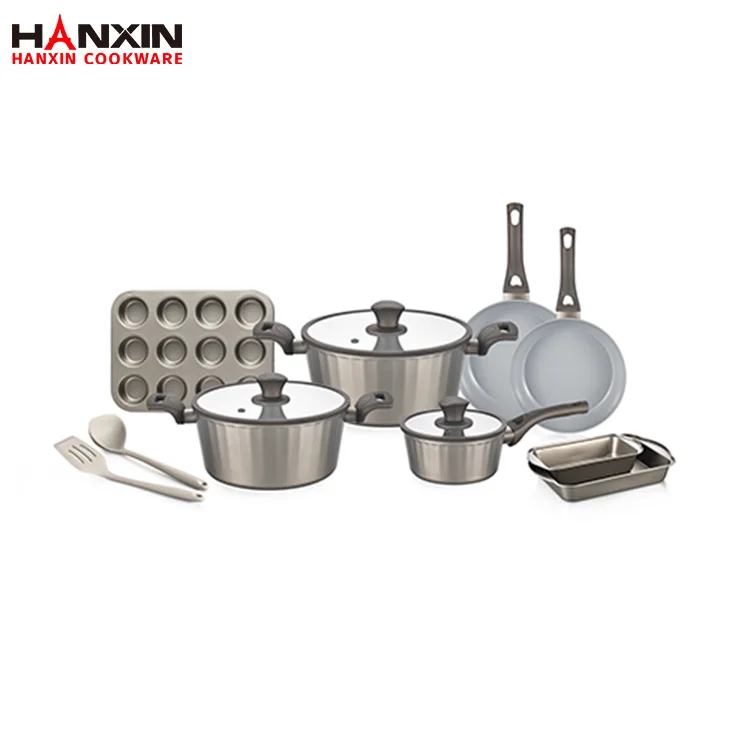
Aluminum Non-Stick Induction Bottom Kitchenware Set
Hanxin Factory's aluminum non-stick induction bottom kitchenware set uses a green non-stick coating and a gradient marble coating on the outside, which enhances visual appeal, creates texture, and creates a unique visual effect. The product is deeply loved by young consumers.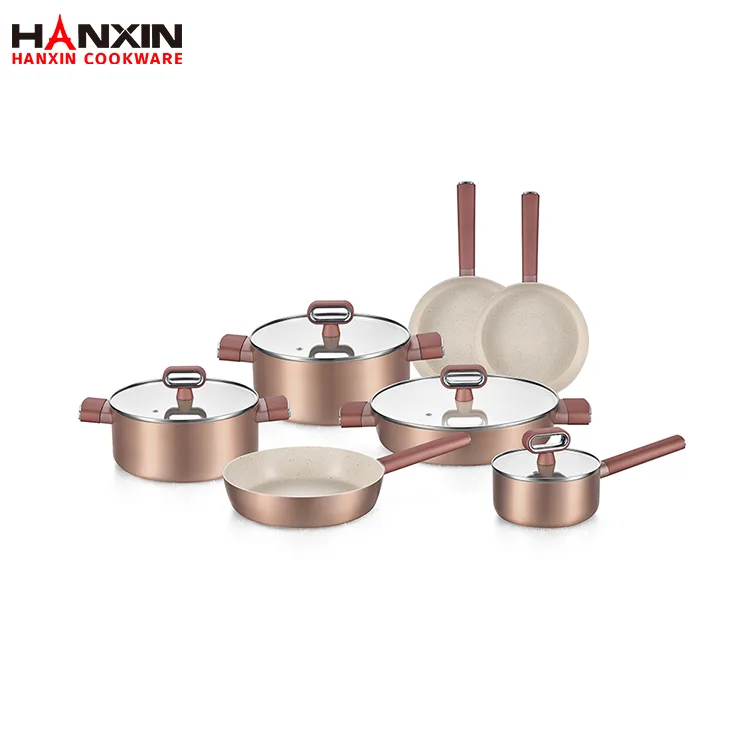
Luxury-Style Golden Color Ceramic Cookware Set
Upgrade your home culinary experience with our Luxury-Style Golden Color Ceramic Cookware Set, a complete kitchen solution built on premium aluminum pressed one-piece forming craftsmanship. Boasting elegant metallic golden exterior finish and food-safe internal ceramic non-stick coating, this comprehensive cookware collection delivers outstanding durability, anti-rust performance and effortless cleaning performance. Compatible with multiple stovetop sources, the set comes with heat-resistant soft-touch handles and glass lids. Manufactured by a own factory with more than 20-year experience in aluminum cookware design and export, this cookware set balances upscale aesthetic appearance and solid practical cooking performance. Available in customizable color options and flexible packaging solutions, it suits household daily cooking, family gatherings and commercial wholesale orders, bringing reliable and delightful cooking moments for every user.
- Related Blog
- Reviews
