
- Home
- About Us
- Products
- Aluminum Ceramic Cookware
- Aluminum Ceramic Cookware Set
- Aluminum Ceramic Kitchenware Set
- Aluminum Ceramic Fry Pan
- Aluminum Ceramic Deep Fry Pan
- Aluminum Ceramic Sauce Pan
- Aluminum Ceramic Casserole
- Aluminum Ceramic Grill Pan
- Aluminum Ceramic Pizza Pan
- Aluminum Ceramic Wok Pan
- Aluminum Ceramic Dutch Oven
- Aluminum Ceramic Saute Pan
- Aluminum Non-Stick Cookware
- Aluminum Non-Stick Cookware Set
- Aluminum Non-Stick Kitchenware Set
- Aluminum Non-Stick Fry Pan
- Aluminum Non-Stick Deep Fry Pan
- Aluminum Non-Stick Sauce Pan
- Aluminum Non-Stick Casserole
- Aluminum Non-Stick Grill Pan
- Aluminum Non-Stick Pizza Pan
- Aluminum Non-Stick Wok Pan
- Aluminum Non-Stick Dutch Oven
- Aluminum Non-Stick Saute Pan
- Composite Stainless Steel Non-Stick Cookware
- Aluminum Ceramic Cookware
- Cases
- News
- Download
- Send Inquiry
- Contact Us

Scratch - Resistant Induction Pan
Purchase directly from a certified China Scratch-Resistant Induction Pan suppliers network. Zhejiang Hanxin Cookware Co., Ltd. builds this heavy-duty cookware line to withstand the abrasive demands of modern busy kitchens, incorporating an ultra-dense aluminum core and a reinforced surface layer.
The Ultimate Scratch-Resistant Ceramic Pan
The single biggest cause of non-stick pan failure is scratching. Even a minor scratch can create a foothold for food to stick, and over time the coating peels or loses its release properties. The Scratch-Resistant Induction Pan addresses this with a ceramic coating engineered to achieve 9H pencil hardness—the same rating as some industrial abrasives—making it significantly more resistant to damage from metal utensils, abrasive sponges, and the wear of daily use.
The scratch resistance comes from the coating’s molecular structure. The ceramic layer is densified during the curing process, with silicon‑oxygen bonds forming a cross‑linked network that is both hard and smooth. This is not a soft topcoat; it is a integrally hard surface that resists penetration and abrasion. In accelerated wear testing, the coating has withstood over 50,000 passes with a standard kitchen scrub pad without losing its release properties.
How Scratch Resistance is Measured and Tested?
Scratch resistance is quantified using the pencil hardness test (ASTM D3363). A set of pencils with increasing hardness (from 6B to 9H) are pressed against the coating at a fixed angle and force. The hardest pencil that does not scratch the surface determines the rating. This Scratch-Resistant Induction Pan achieves 9H, meaning it is resistant to the hardest pencil lead typically used in consumer cookware testing.
In comparison:
• PTFE coatings generally rate 2-3H.
• Standard ceramic coatings often rate 4-6H.
• This pan’s coating consistently scores 9H.
This superior hardness means the pan can withstand occasional contact with metal spatulas, whisks, and serving spoons without immediate damage. However, we still recommend using silicone or wood utensils for optimum longevity.
Technical Specifications
| Specification | Detail |
| Material | High-Grade Aluminum Alloy |
| Coating Type | Scratch-Resistant Ceramic Non-Stick (9H Hardness) |
| Available Sizes | 20cm, 22cm, 24cm, 28cm (with lid) |
| Bottom Design | Induction-Ready Multi-Layer Bonded Base |
| Stovetop Compatibility | All Stovetops Including Induction |
| Oven Safety | Up to 500°F (260°C) |
| Utensil Compatibility | Metal utensils acceptable (though not recommended) |
Real-World Scratch Tests
We conducted a series of tests simulating typical kitchen wear:
• Metal spatula edge test: A stainless steel spatula was scraped across the coating at a 45° angle with moderate pressure for 200 strokes. The coating showed only superficial marks, with no deep scratches or loss of non-stick.
• Steel wool rub test: Grade #00 steel wool was rubbed over the surface for 20 cycles. The coating remained intact, though it developed a slight dullness that was easily removed with a gentle cleaner.
• Stacking impact test: Another pan was dropped onto the cooking surface from a height of 10 cm. The coating did not chip or crack.
These tests confirm that the Scratch-Resistant Induction Pan can withstand the wear and tear of a busy kitchen without immediate failure. This durability translates to a longer useful life, making it a more cost-effective choice in the long run.
Competitive Benchmark: Scratch Resistance Comparison
| Test Scenario | This Pan (9H Ceramic) | Standard Ceramic (6H) | PTFE Coating (3H) |
| Metal Spatula (200 strokes) | Superficial marks only | Visible scratches | Deep scratches |
| Steel Wool (#00, 20 rubs) | Dullness only | Scratches | Coating worn through |
| Stacking Drop (10cm) | No damage | Minor chipping | Chipping |
| Non-Stick After Scratching | Maintained | Reduced | Significantly reduced |
| Expected Coating Lifespan | 4-6 years | 2-3 years | 1-2 years |
Maintenance Tips for Maximum Scratch Resistance
While the coating is exceptionally hard, its longevity still depends on care:
• Use wooden, silicone, or nylon utensils whenever possible. Metal is acceptable but avoid forceful scraping.
• Avoid cutting food directly in the pan with a knife—this can cause localized damage even on hard coatings.
• Do not use abrasive cleaners such as steel wool or powdered cleansers. A soft sponge and mild detergent are sufficient.
• Store the pan with a protective layer (e.g., a paper towel) between it and other pans to prevent scratches from metal edges.
• Avoid overheating the pan empty—extremely high temperatures can weaken the coating over time.
Frequently Asked Questions
Q1: Can I use metal utensils on this pan?
Yes, the coating is scratch-resistant enough to withstand occasional use with metal utensils. However, for maximum longevity, we recommend using softer materials.
Q2: Will the non-stick properties wear off if the pan gets scratched?
Minor surface scratches are unlikely to affect the non-stick performance because the coating is thick and homogeneous. Deep cuts that penetrate the coating might reduce performance.
Q3: How does the 9H hardness compare to other coatings?
9H is the highest common rating for cookware coatings. Most PTFE coatings rate 2-3H, and standard ceramics rate 4-6H. This pan’s coating is among the hardest available.
Q4: Is the coating safe if it does scratch?
Yes. The coating is non-toxic and biologically inert. Even if small particles were to be ingested, they are harmless.
Q5: How long will the scratch resistance last?
With normal care, the Scratch-Resistant Induction Pan coating maintains its hardness for the life of the pan. It is not a surface treatment that wears away; it is the bulk material of the coating.
Related Products




Hot Products

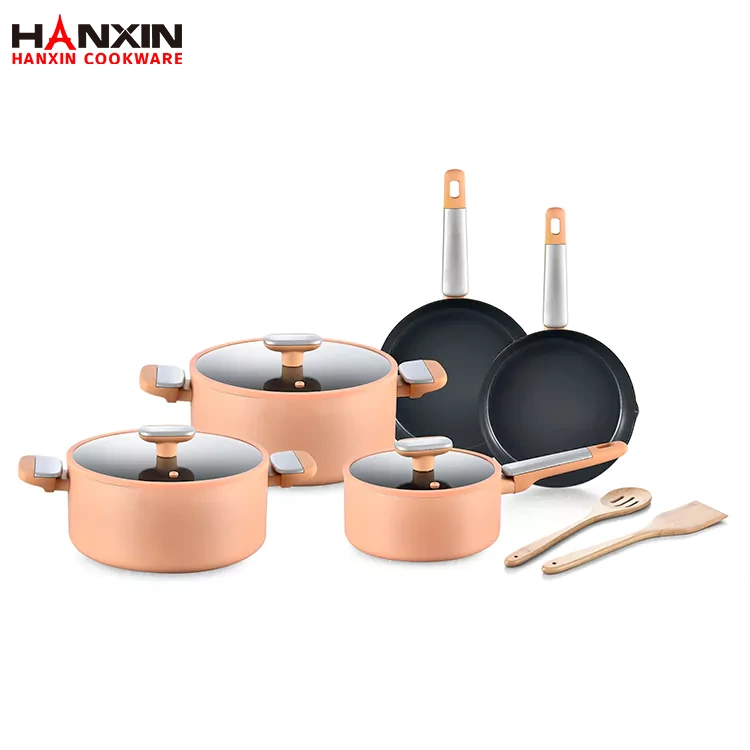
Aluminum Pressed Non-Stick Dutch Oven
This Aluminum Pressed Non-Stick Dutch Oven, which is SGS approved. Non-toxic, free of PTFE, PFAS, PFOA, PFOS, lead, cadmium and other toxic substances that can leach into food.
Aluminum Non-Stick Granite Coating Casserole
HANXIN Aluminum Non-Stick Granite Coating Casserole features high-performance nonstick coating on both interior and exterior, making cooking and cleaning effortless. This lightweight casserole boasts an elegant design, durable nonstick surface, and green healthy properties, ideal for crafting all kinds of delicious meals for your family.
Aluminum Non-Stick Marble Coating Casserole
HANXIN Aluminum Non-Stick Marble Coating Casserole features a premium non-stick marble coating, and is completely free of PTFE, PFOA, lead, cadmium and other toxic materials that could leach into your food. It’s a reliable, safe choice for you, your family and the environment.
Aluminum Non-Stick Marble Coating Grill Pan
This Aluminum Non-Stick Marble Coating Grill Pan ,which Eco-friendly Non-Stick Granite Coating & Super Easy to Clean - Our grill pan interior is coated by non-stick granite coating, SGS approved, 100% PFOA free. Require less oil or butter for cooking and minimal scrubbing for a spotless clean, giving you a healthier and more enjoyable at-home cooking experience.
Aluminum Non-Stick Marble Coating Kitchenware Set
This Aluminum Non-Stick Marble Coating Kitchenware Set is also another patented product of Hanxin. These series of products which is carried out based on the concept of mermaids by our research and development. The design concept is to be close to the sea and to be healthy and environmentally friendly. so this product is extremely popular among the general public.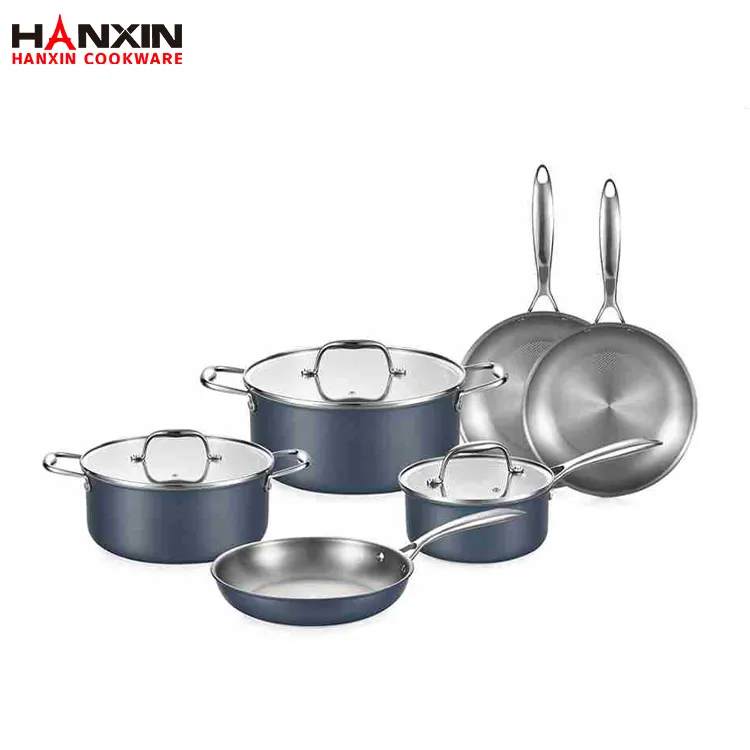
Aluminum-304 Stainless Steel Composite Non-Stick Cookware Set
Source the Aluminum-304 Stainless Steel Composite Non-Stick Cookware Set directly from our factory. Designed with an aluminum exterior layer and a 304 stainless steel interior layer, this cookware set combines efficient heat transfer, durable food-contact material, and convenient non-stick performance. The water-based non-stick system supports smooth food release and easy cleaning, making the set suitable for household cooking, retail cookware collections, and OEM/ODM projects. Factory-direct supply, strict QC, sample support, and bulk order service are available.
- Related Blog
- Reviews
