
- Home
- About Us
- Products
- Aluminum Ceramic Cookware
- Aluminum Ceramic Cookware Set
- Aluminum Ceramic Kitchenware Set
- Aluminum Ceramic Fry Pan
- Aluminum Ceramic Deep Fry Pan
- Aluminum Ceramic Sauce Pan
- Aluminum Ceramic Casserole
- Aluminum Ceramic Grill Pan
- Aluminum Ceramic Pizza Pan
- Aluminum Ceramic Wok Pan
- Aluminum Ceramic Dutch Oven
- Aluminum Ceramic Saute Pan
- Aluminum Non-Stick Cookware
- Aluminum Non-Stick Cookware Set
- Aluminum Non-Stick Kitchenware Set
- Aluminum Non-Stick Fry Pan
- Aluminum Non-Stick Deep Fry Pan
- Aluminum Non-Stick Sauce Pan
- Aluminum Non-Stick Casserole
- Aluminum Non-Stick Grill Pan
- Aluminum Non-Stick Pizza Pan
- Aluminum Non-Stick Wok Pan
- Aluminum Non-Stick Dutch Oven
- Aluminum Non-Stick Saute Pan
- Composite Stainless Steel Non-Stick Cookware
- Aluminum Ceramic Cookware
- Cases
- News
- Download
- Send Inquiry
- Contact Us

Lightweight Induction Saute Pan
Expand your retail inventory with our specialized Lightweight Induction Saute Pan, available for wholesale from Zhejiang Hanxin Cookware Co., Ltd. We have re-engineered the classic deep skillet to reduce unnecessary weight while keeping a thick, durable 0.25-inch base for reliable cooking performance.
The Ergonomics of Lightweight Cookware
Ergonomics is not just about comfort—it also affects safety. Heavy pans are harder to control when pouring hot liquids, increasing the risk of spills and burns. A lighter pan allows for more precise movements, especially when performing quick flips or tossing. The handle is also designed with a comfortable grip and a slight upward angle to reduce wrist strain during lifting.
For users with arthritis or reduced hand strength, the lightweight construction makes cooking less taxing and more enjoyable. We have received feedback from elderly users that they can now use a 28cm pan without assistance, something they could not do with cast iron.
Lightweight Induction Design
Cookware weight is often overlooked until you need to lift a heavy pan full of food. The Lightweight Induction Saute Pan weighs approximately 1.5 kg for the 28cm size—less than half the weight of a comparable cast iron pan. This is a significant advantage for home cooks who may have limited strength, for elderly users, or for anyone who appreciates easy maneuverability when tossing food or transferring the pan from stove to sink.
The pan’s lightness is achieved without compromising durability. The aluminum alloy body is thick enough to provide structural integrity but is inherently lighter than steel or iron. The bonded induction base adds only a thin steel layer, which does not significantly increase weight. This design means you can still enjoy the benefits of induction cooking—rapid, even heat—without the fatigue that comes from heavy cookware.
Weight Comparison Across Cookware Types
We measured the actual weight of 28cm Lightweight Induction Saute Pans from various materials (all with lid included).
| Pan Type | Weight (kg) | Ease of Handling (1-10) |
| This Lightweight Induction Pan | 1.5 | 9 |
| Stainless Steel Pan | 2.2 | 6 |
| Cast Iron Pan | 4.5 | 3 |
| Hard Anodized Aluminum (non-induction) | 1.8 | 8 |
The lightweight nature of this pan makes it easier to:
• Lift and pour contents (e.g., removing hot oil or liquids).
• Toss food for even cooking (a technique difficult with heavy pans).
• Move from stovetop to oven and back (though the pan is oven-safe, the weight reduction is appreciated).
• Clean—a lighter pan is easier to hold under running water and scrub.
Competitive Positioning: Weight and Usability
| Factor | This Pan | Cast Iron | Stainless Steel |
| Weight (28cm) | 1.5 kg | 4.5 kg | 2.2 kg |
| Ease of Tossing | Excellent | Poor | Moderate |
| Wrist Strain Risk | Low | High | Moderate |
| Oven Transition Ease | Easy | Difficult | Moderate |
| Induction Compatible | Yes | Yes | Depends |
Balancing Weight with Durability
Some users might wonder if a lighter pan is less durable. In this case, the aluminum alloy is robust enough to resist warping and denting under normal use. The bonded base ensures the Lightweight Induction Saute Pan remains stable on induction. The ceramic coating is also durable, as discussed in previous sections. The only trade-off is that aluminum pans cannot be used on very high heat for extended periods (which is not recommended for any non-stick pan), but for everyday cooking, the weight advantage outweighs this limitation.
Frequently Asked Questions
Q1: Is a lightweight pan less stable on the stovetop?
No. The pan’s flat base and bonded induction layer keep it stable. Stability depends more on flatness than weight.
Q2: Can I still get a good sear with a lightweight pan?
Yes. Aluminum conducts heat efficiently, so searing is excellent. Weight is not a factor in heat transfer.
Q3: Is the lid also lightweight?
The lid is made of stainless steel with a glass insert, which is standard weight. It is not significantly heavy.
Q4: Is this Lightweight Induction Saute Pan suitable for induction?
Yes, the bonded induction base makes it fully compatible.
Q5: How does the pan’s weight compare to hard-anodized aluminum?
It is lighter than most hard-anodized pans because the base does not require a thick steel plate—just a thin bonded layer.
Related Products




Hot Products

Aluminum Pressed Non-Stick Dutch Oven
This Aluminum Pressed Non-Stick Dutch Oven, which is SGS approved. Non-toxic, free of PTFE, PFAS, PFOA, PFOS, lead, cadmium and other toxic substances that can leach into food.
Aluminum Non-Stick Granite Coating Casserole
HANXIN Aluminum Non-Stick Granite Coating Casserole features high-performance nonstick coating on both interior and exterior, making cooking and cleaning effortless. This lightweight casserole boasts an elegant design, durable nonstick surface, and green healthy properties, ideal for crafting all kinds of delicious meals for your family.
Aluminum Non-Stick Marble Coating Casserole
HANXIN Aluminum Non-Stick Marble Coating Casserole features a premium non-stick marble coating, and is completely free of PTFE, PFOA, lead, cadmium and other toxic materials that could leach into your food. It’s a reliable, safe choice for you, your family and the environment.
Aluminum Non-Stick Marble Coating Grill Pan
This Aluminum Non-Stick Marble Coating Grill Pan ,which Eco-friendly Non-Stick Granite Coating & Super Easy to Clean - Our grill pan interior is coated by non-stick granite coating, SGS approved, 100% PFOA free. Require less oil or butter for cooking and minimal scrubbing for a spotless clean, giving you a healthier and more enjoyable at-home cooking experience.
Aluminum Non-Stick Marble Coating Kitchenware Set
This Aluminum Non-Stick Marble Coating Kitchenware Set is also another patented product of Hanxin. These series of products which is carried out based on the concept of mermaids by our research and development. The design concept is to be close to the sea and to be healthy and environmentally friendly. so this product is extremely popular among the general public.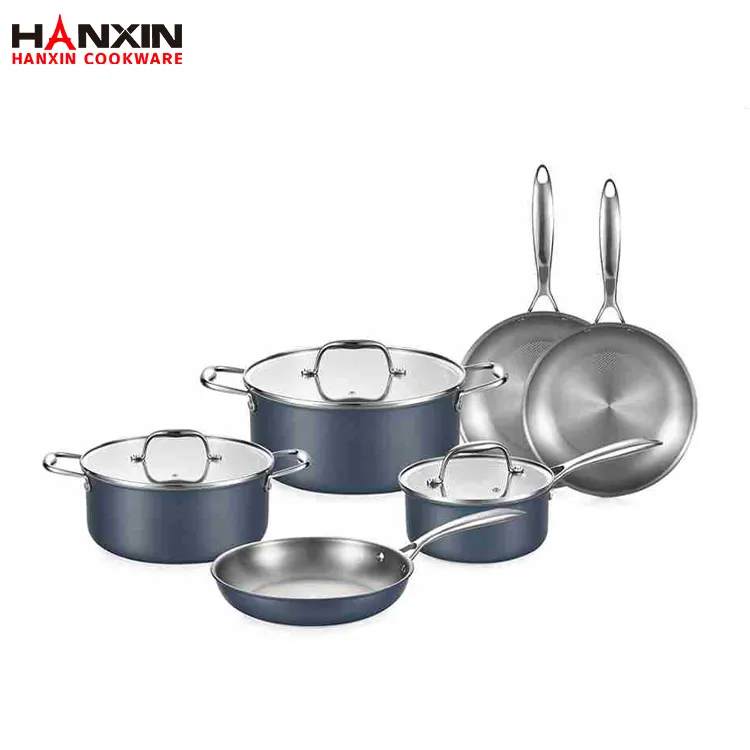
Aluminum-304 Stainless Steel Composite Non-Stick Cookware Set
Source the Aluminum-304 Stainless Steel Composite Non-Stick Cookware Set directly from our factory. Designed with an aluminum exterior layer and a 304 stainless steel interior layer, this cookware set combines efficient heat transfer, durable food-contact material, and convenient non-stick performance. The water-based non-stick system supports smooth food release and easy cleaning, making the set suitable for household cooking, retail cookware collections, and OEM/ODM projects. Factory-direct supply, strict QC, sample support, and bulk order service are available.
- Related Blog
- Reviews
